|
you are here:
Kidger
Home
/
Michael Kidger Memorial Scholarship / Awardees / Winner 2001
Michael Kidger Memorial Scholarship:
2001 AWARDEE -
Chunyu Zhao
|
|
|

Kidger Scholarship Awardees at the:
International Optical Design Conference
(IODC) 2017
Denver, CO, USA,
12 July 2017
Dewen Cheng, Yunfeng Nie, Florian Fournier,
Liying Chen,
Chunyu Zhao,
Fabian Dürr
|
|
|
 Update 2020
Chunyu designs and manufactures Computer Generated Holographs (CGHs) at Arizona Optical Metrology LLC
(www.cghnulls.com),
where he has been President since April 2014 and previously served as chief engineer from June 2009 to April 2014. His co-founder, business partner and former thesis advisor is Professor Jim Burge of University of Arizona.
Chunyu with Family 2020
L-R: Andy, Fang (wife),Jian Quiang (Jerry)

Update 2014
Chunyu is an invited speaker at the International Optical Design Conference (IODC), 22-26 June 2014,
The Fairmont Orchid, Kohala Coast, Hawaii. The topic of his paper will be the design of a Progressive Addition Lens (PAL) using newly developed curvature polynomials. The newly developed curvature polynomials are considered ideal candidates for representing the power and astigmatism distribution of a PAL.
Update 2010
"I'm currently working at the University of Arizona, College of Optical Sciences. My primary job here is to design and build optical systems for testing aspheric mirrors for astronomical telescopes, particularly the interferometric null test systems employing Computer Generated Holograms (CGHs). I co-founded Arizona Optical Metrology LLC to provide CGHs for optical testing, as well as consulting services for optical metrology system design and analysis. I am also pursuing research in further understanding of the origins of aberrations, the coherent imaging aberrations in the optical testing systems and their impact on the testing accuracy."
|
Award Year 2001
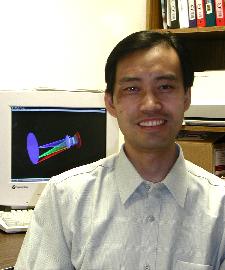
Chunyu Zhao, a Ph.D. candidate at the Optical Sciences Center, University of Arizona, Tucson, Arizona, USA was selected as the 2001 Michael Kidger Memorial Scholarship awardee. Chunyu was selected by an international committee of academic and industrial specialists in optical design. His award was presented by Tina Kidger on 31 July 2001.
An Interview by Cathy Alexander, Optical Sciences Center, University of Arizona follows:
Chunyu Zhao is a PhD candidate at the Optical Sciences Center, The University of Arizona, Tucson, Arizona, USA. He received a bachelor’s degree in Applied Physics with a specialty in Optics from Tsinghua University in Beijing, China. After graduation he worked in industry for several years before applying to Temple University in Philadelphia, where he
partook of the Physics Department’s Master’s program. Chunyu is currently working on his dissertation
at the Optical Sciences Center entitled "The Criteria for Correcting all the Quadratic Field-Dependent Aberrations."
His advisor is Professor James Burge. "Dr. Burge is a very experienced optical designer and a great mentor. In addition to Professor Burge, I also appreciate the assistance of Professor Jose Sasian and Professor Roland Shack. They are always willing to help work out problems that I come across and I learn new things every time I talk to them."
 Chunyu’s interest in optical design began only a few years ago at the Optical Sciences Center when he discovered the story of H. Dennis Taylor’s invention of the Cooke Triplet. "It is such an elegant design," he said. "Even with all of the excellent design software on the market now, optical design is still a knowledge-intensive business and, because optical systems are becoming more and more complicated, I think it always will be."
"At the Optical Sciences Center, I’ve been fortunate to be involved in several projects, including an exciting project for Jim Burge: building an interferometer that was used to test the prototype for NGST, the Next Generation Space Telescope. Other work included developing a theory for correcting aberrations and a related project involved designing well-corrected all aspheric-surface systems under the guidance of that theory. My current project is my dissertation research."
Chunyu’s dissertation is focused on the development of a criterion for
correcting all the quadratic field-dependent aberrations of an optical system.
"The criterion for an axially symmetric system has been derived and involves
only the properties of the rays originating from the on-axis object point, but
it predicts off-axis aberrations with quadratic field dependence. The constant optical path difference, or OPD condition, the Sine Condition, and the criterion correct aberrations of all orders of pupil dependence, the three conditions can be combined to design optical systems with very high numerical aperture and moderate field of view. So far, I have designed a four-surface system that satisfies all three conditions to prove the concept of imposing them in optical design. As far as I know, the result of this research is new to the optical design community. It has applications to high-resolution system design, but its full potential is still unknown."
Chunyu said, "I’m very honoured to be chosen to receive the Michael Kidger Memorial Scholarship.
I would like to thank The Michael Kidger Memorial Scholarship Committee for this generous scholarship and HP Labs for the laptop and printer."
|
|