
Geoffroi Côté: 2021 Awardee
Michael Kidger Memorial Scholarship
Université Laval
The 2021 winner of the Michael Kidger Memorial Scholarship award is Geoffroi Côté. Geoffroi received an undergraduate degree in Engineering Physics from Université Laval, Québec City, Québec, Canada, in 2017. In 2017, he was awarded 1st place for Innovative Design in the Quebec Engineering Competition (Rimouski). Geoffroi entered the PhD program at Université Laval on a ‘Fast Track’ following the award of a Master’s degree in 2019. He is currently in his second year of the PhD program at Université Laval under the tutelage of Professor Simon Thibault, an OSA & SPIE Fellow and holder of the NSERC Industrial Chair in Optical Design. Geoffroi is co-advised by Professor Jean-François Lalonde, Computer Vision and Systems Laboratory, Faculty of Science and Engineering, Université Laval, Québec City, Canada.
Professor Thibault comments: “Geoffroi’s thesis is on deep learning in lens design. Many researchers have claimed over the past years that AI will have a huge impact on future optical design. It is my belief that Geoffroi has achieved this vision. The work he is doing is certainly the first useful AI application available for the entire lens design community.”
The 2021 Kidger Scholarship Award was presented to Geoffroi by Professor Simon Thibault at Université Laval on 21 June 2021. Tina Kidger announced Geoffroi’s award during OSA’s International Optical Design Conference (IODC), 28 June 2021, Providence, Rhode Island, USA, following the conference introduction by Stephen Fantone, OSA Immediate Past President.
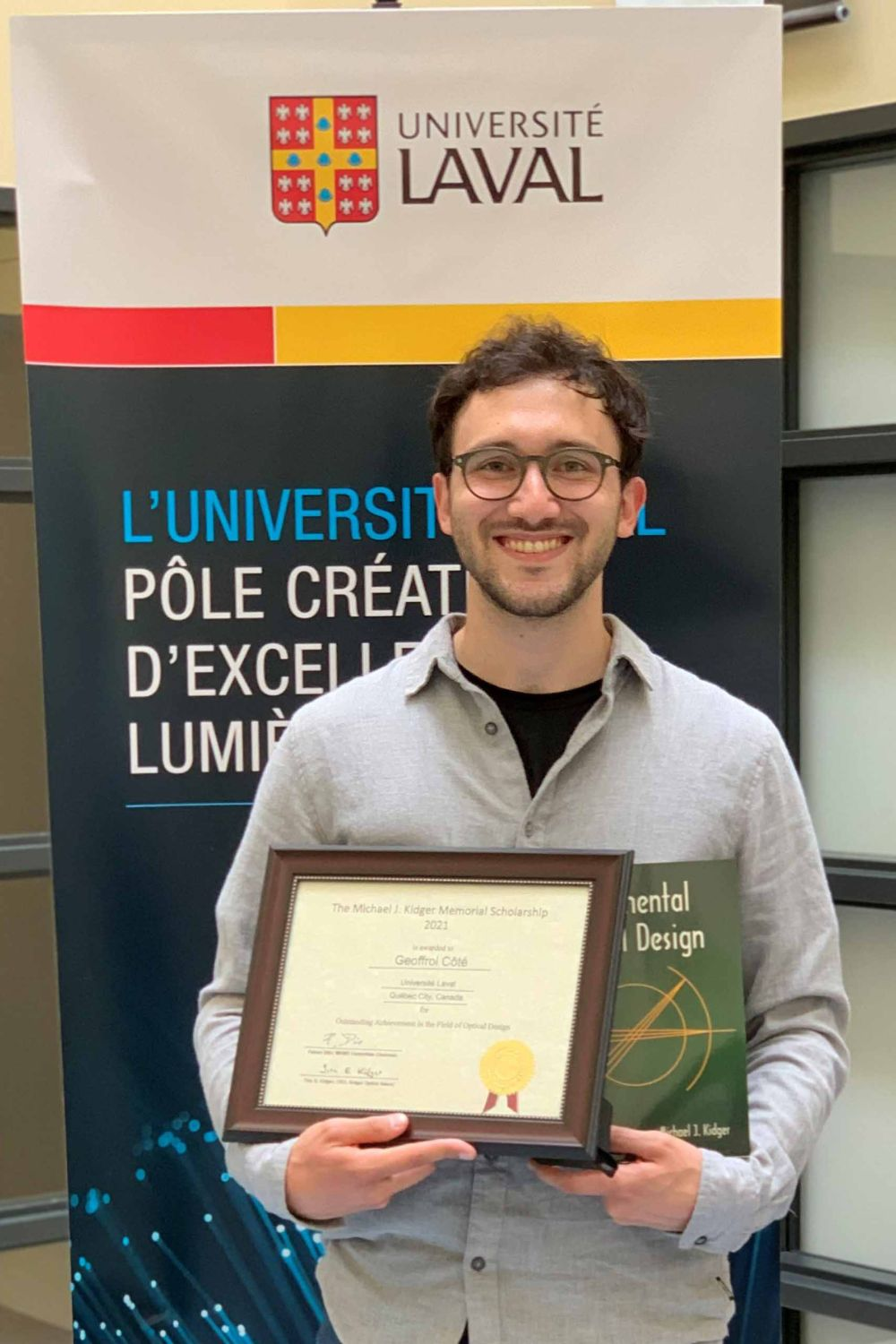
GEOFFROI CÔTÉ
with Award Certificate
+ Michael Kidger’s
“Fundamental Optical Design”
Research Highlights
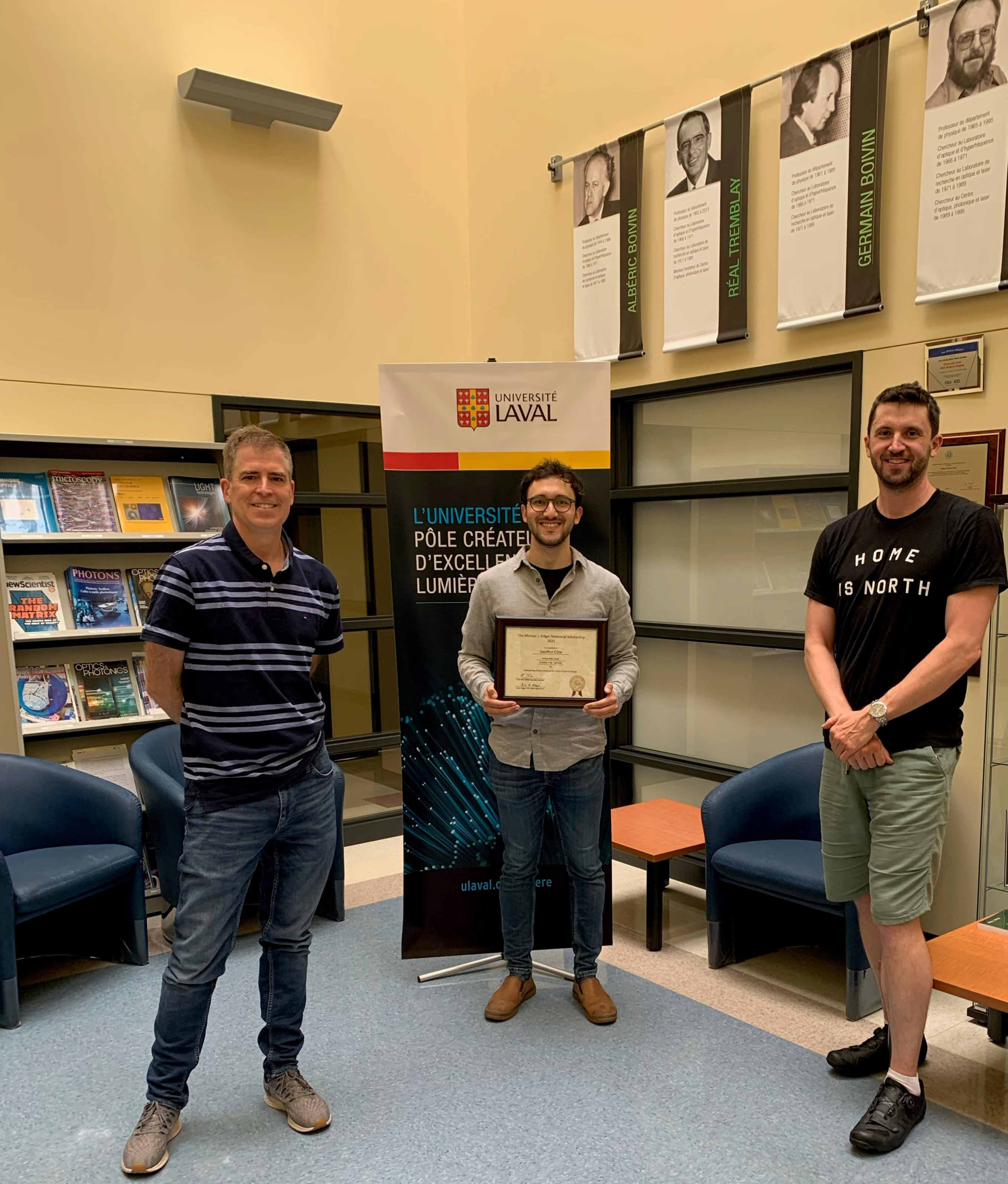
GEOFFROI CÔTÉ
with thesis advisor
Professor SIMON THIBAULT
and co-advisor
Professor JEAN-FRANCOIS LALONDE

GEOFFROI At IODC 2023
with TINA KIDGER, Award Founder
and FABIAN DÜRR, Awd Comm Chair
“During my undergraduate studies in engineering physics, I was immediately hooked by the elegant and layered mathematical model for optics, ranging from straightforward paraxial optics to the more subtle photonics, and the wide variety of phenomena it could explain. I was eager to put my knowledge to work during internships in academia and industry where I did research on medical, panoramic and enhanced depth-of-field imaging, and developed a growing interest for research in optics.
“At the beginning of my graduate studies, with courses in both machine learning and lens design, I soon came to the realization that there was a lot to gain in lens design by casting the problem as a learning one, and to my surprise, the literature held little information on this topic. Witnessing the strong emergence of deep learning, I asked myself: how can lens design benefit from this? As I found out, one answer to this question was to extrapolate from lens design databases, in the hope of extracting the features of what makes a lens design successful, and combine them to address other specifications or lens configurations.
“Aside from implementing natural extensions to our framework (modeling aspherical surfaces, extending to other wavelengths, …), I want to create more data-driven tools for lens designers, such as the idea of “training” an optimizer on the landscape of typical lens design merit functions, or using reinforcement learning to add or remove lens elements as the optimization progresses.”
As of 2023, Geoffroi is a post-doctoral researcher in Artificial Intelligence and Optics at Princeton University.