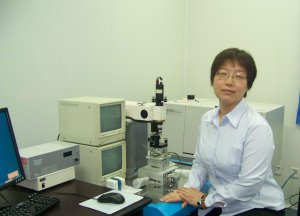
Xuemin Cheng: 2003 Awardee
Michael Kidger Memorial Scholarship
Beijing Institute of Technology
Xuemin Cheng, a Ph.D. student at Beijing Institute of Technology, Beijing, China, was selected as the 2003 Michael Kidger Memorial Scholarship awardee. Her doctoral research, supervised by Prof. Wang, focuses on developing intelligent computer-aided design techniques for optical systems, with an emphasis on global optimization methods for complex optical designs.
The award was presented by Tina Kidger at the Optical Systems Design conference, St. Etienne, France, on 30 September 2003. The award included a cash award, partially supported by Thales Optics Ltd (later to become Qioptiq Ltd), and a laptop computer plus peripherals donated by Hewlett-Packard Laboratories.

Research Highlights
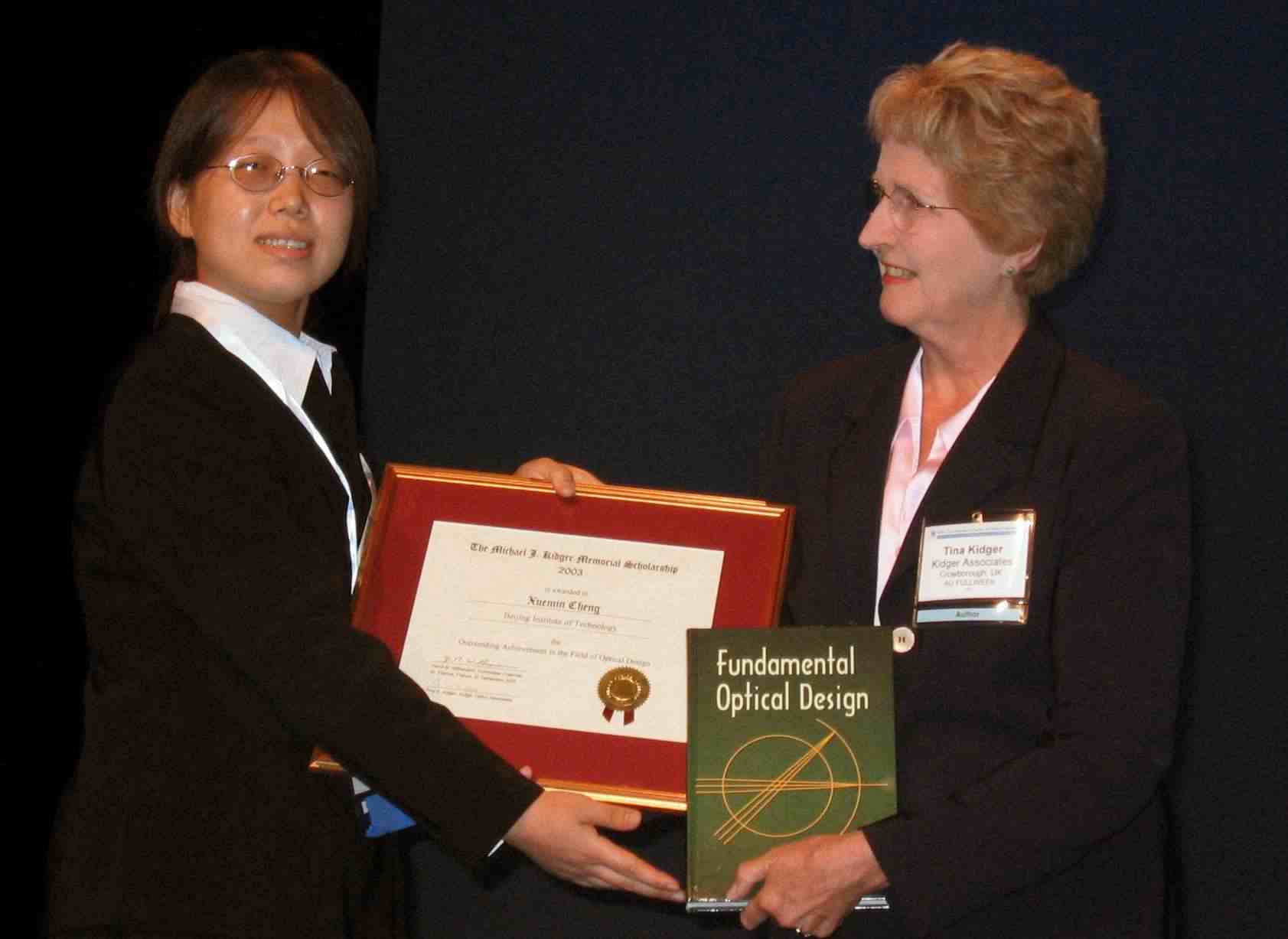
Xuemin receiving the 2003
Award Certificate from Tina Kidger
St Etienne, France, 30 Sep 03
“The project of my Ph.D. research is: “Techniques for Intelligent Computer-Aided Design of Optical Systems.” I started my research by helping Prof. Wang to implement a global optimization feature into the GOLD optical design program. This type of global optimization consists of many local optimization runs with or without the escape function using the DLS method. Its efficiency depends on the effectiveness of the local DLS optimization, as well as, the correct choices of escape function parameters. The implementation of search schemes for the optimum global damping factor and solution vector length accelerated the convergence of DLS optimization and enhanced the performance. The algorithm is successfully implemented in the GOLD program, which becomes an optical software package with a practical global optimization feature for the design of complex optical systems.
“In order to further improve the intelligence of the computer-aided design, we established a mechanism for the automatic addition and deletion of optical elements in lens optimization. The criteria used in the scheme employs two lens form parameters, quantifying the symmetry of the optical system and the optical power distribution among the individual lens elements. Experiments show that the scheme is capable of selecting the optimum position for adding an optical surface or element when it is needed to overcome the stagnation of an optimization process, and of observing and deleting a redundant element automatically without impairing the performance of the system.
“I am also taking part in the project of setting up an expert system for the automatic generation of the initial layout of a zoom lens. It includes the development of optimization algorithms to determine the Gaussian parameters for different zoom mechanisms, and the establishment of a lens group database from which the structure of each lens group in a zoom system can be selected according to the specifications.
“Another aspect of optimization that I am planning to study is the way to deal with discrete variables, namely, glass materials. I think that optimization algorithms, such as those available using neural network techniques, should be able to handle the glass variables effectively, provided we give the program a correct model of the optical design problem.”
Updates
2020
Xuemin Cheng is currently an associate professor of Tsinghua University (Shenzhen International Graduate School). Her research interests are optical design and engineering, including imaging system design, illumination system design, and optical modeling and simulation. Her current projects include: stabilized zoom lens design and application, instrumentation on polarized microscopy, instrumentation on plankton imaging and classification, compressive imaging and smart imaging through scattering mediums. Recently, an image processing and identification device has passed inspection and approval. The device can be used for in-situ monitoring and intelligent identification of various dominant plankton, such as copepods, medusae, chaetognatha, fish larvae, and Noctiluca. It has good application prospects in marine ecological management and can provide forecasts and early warnings for potential ecological disasters.
2010
Dr. Xuemin Cheng received her PhD degree in optical engineering from Beijing Institute of Technology in 2004. In 2006, her doctoral dissertation was awarded the National Excellent Doctoral Dissertation in China. She is currently an associate professor of optics in the Graduate School in Shenzhen, Tsinghua University. Her research areas are intelligent computer-aided design (ICAD) of optical systems, aspheric lens design and fabrication, and optical data storage. Her current projects focus on optical engine modules of complex optical systems, the R&D and industrialization of high-density optical memory technology, and intelligent interactive projection systems.
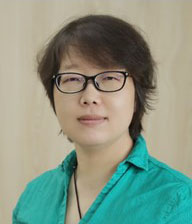
Xuemin in 2020