you are here: Kidger Home / Michael Kidger Memorial Scholarship / Awardees / Winner 2008

Michael Kidger Memorial Scholarship: AWARDEE - TOBIAS SCHMID


Update 2010
I am presently a Graduate Research Assistant, PhD Candidate Optics, CREOL - The College of Optics and Photonics at the University of Central Florida. My research interests have been focused on the design and analysis of optical systems without rotational symmetry. This includes systems that are intentionally designed without symmetry, or misaligned optical systems that exhibit rotational symmetry in their nominal state. Having a mathematical framework to understand the effects of misalignment perturbations, concepts have been developed that can dramatically reduce assembly tolerances. Most recently I had the opportunity to work with scientists from the LSST Corporation to develop an alignment plan for the Large-Synoptic-Survey-Telescope. While my research has been mainly focused on astronomical telescopes, numerous other applications exist, e.g. optical testing applications, microlithography, tolerancing etc.


Award Year 2008
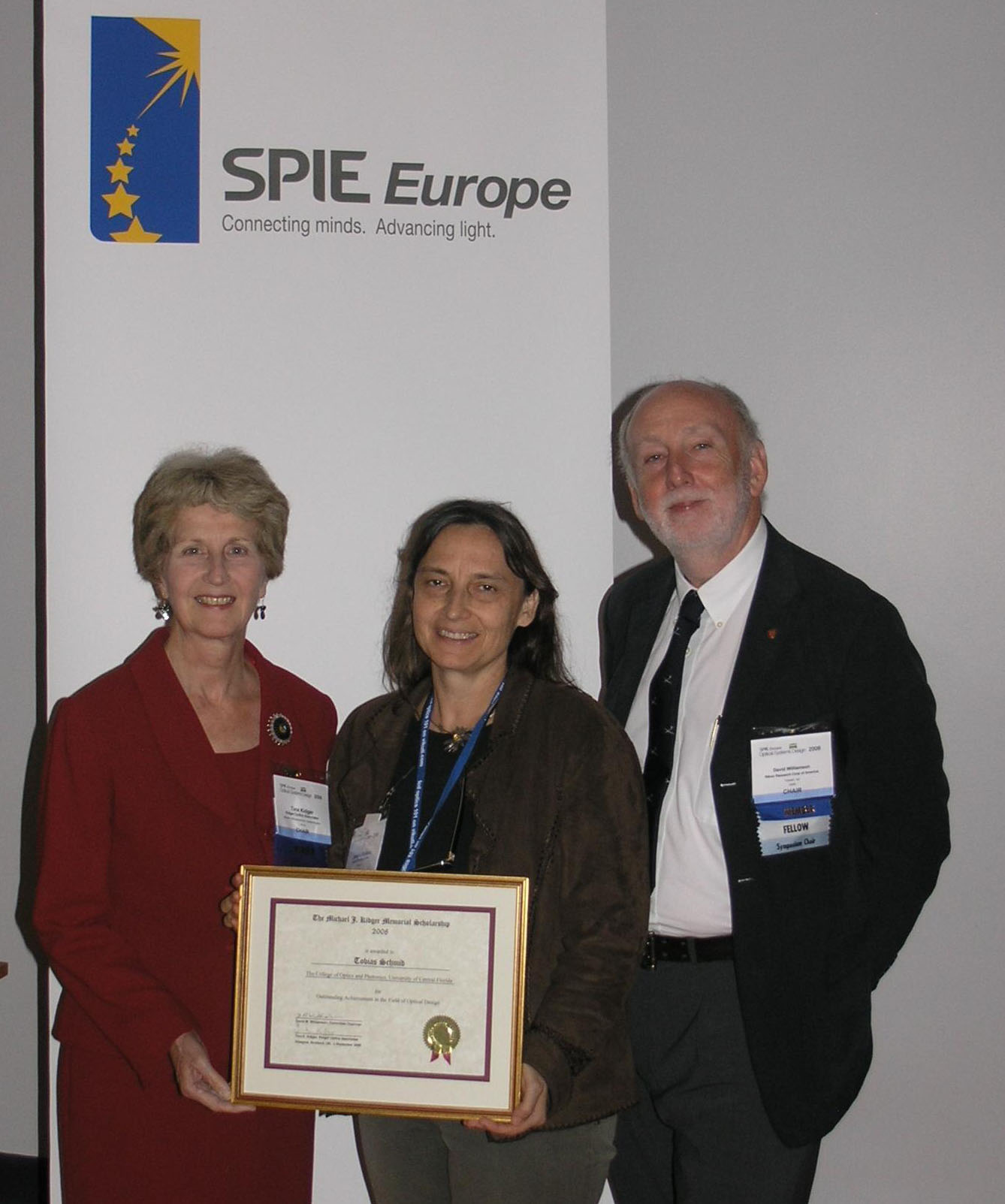
Tobias Schmid, a PhD Candidate at CREOL - College of Optics and Photonics, University of Central Florida, was selected as the 2008 Michael Kidger Memorial Scholarship awardee. Tobias' thesis supervisor is Jannick Rolland PhD, Professor of Optics and Computer Science, College of Optics & Photonics, CREOL, University of Central Florida. The award was presented at the SPIE Europe Optical Systems Design Symposium on 2 September 2008, Glasgow Caledonian University, Glasgow, Scotland, UK by Tina Kidger. The award consisting of a $5,000 cash grant, supported by the Michael Kidger Memorial Scholarship Fund, was received for Tobias by his thesis supervisor, Professor Jannick Roland.

Tobias' research focus is on applying and extending Nodal Aberration Theory, which describes aberration fields of misaligned optical systems, originally developed in the 1970s by Kevin Thompson. A recent contribution has been the development of a coordinate system independent formulation of the method for locating aberration field centers. This new ‘real ray’ based approach enables a working optical designer using a commercial optical design package to directly predict aberration field nodal behavior as a function of misalignment. The previous methods, based on an extended paraxial treatment by Buchroeder, were limited to a specific type of tilt and decenter model whereas a designer typically has access to, and uses, up to 5 different methods for managing tilt and decenter modeling.

The equivalence of both approaches to calculate the aberration field center locations has been demonstrated and is shown in a paper recently submitted to JOSA A. The calculation of the aberration field centers has been implemented in CODE V where it is combined with Full Field Displays and with macros developed to compute the characteristic quantities in Nodal Aberration Theory. The results were successfully validated based on real raytracing and subsequent fit to Zernike polynomials; a completely independent methodology for verification purposes.

Most recently Tobias has been applying Nodal Aberration Theory to fully describe alignment induced aberrations on a surface-by-surface basis for a wide class of astronomical telescopes. Not only total aberration at the image plane, but also effects originating from each surface can be analyzed separately. Because nodal location is linear with perturbation, the resulting insights from applying these tools enables a fundamental understanding of misalignment effects, which can provide valuable insight in the process of developing an alignment plan. Tobias has also recently undertaken research into aberations of rotationally non-symmetric optical systems which has application in many domains including EUV lithography.

Professor Jannick Rolland
receiving award for Tobias from
Tina Kidger and David Williamson
at SPIE Europe Symposium
Glasgow, Scotland  2 Sept 2008


     ® 2010 Kidger Optics Associates. All rights reserved.